DeepLegal: Agentic AI RAG for Legal Research


"In the legal sector, accuracy is non-negotiable. DeepLegal allows us to offer our clients a tool that not only accelerates research, but guarantees full source verifiability and the highest security for sensitive data."
Challenge
Lawyers dedicate a substantial amount of their time to manual research across regulations, rulings, and case law precedents. This process is fundamental to building solid arguments, but it is also:
Time-consuming. Hours of research in legislative archives and case law databases to find relevant references;
Prone to incompleteness. The risk of failing to identify relevant precedents or applicable regulations;
Difficult to scale. As the volume of laws and rulings grows, manual research becomes progressively less sustainable.
The legal sector needed an intelligent assistant for research and brainstorming that could:
Rapidly query enormous volumes of legal documents;
Provide accurate answers with verifiable citations;
Maintain the highest security and regulatory compliance for sensitive data.
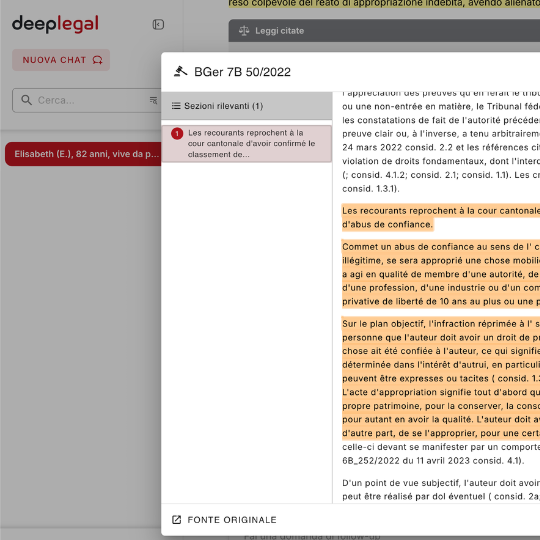
DeepCloud is a Swiss company specialising in technology solutions to streamline business services and performance. With DeepLegal, DeepCloud set out to create a platform dedicated to the legal sector, combining artificial intelligence with the rigorous precision demanded by legal and jurisprudential practice.
Our AI Solution
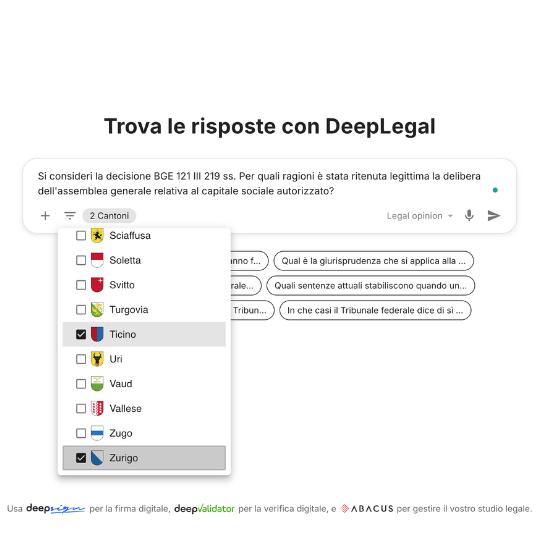
Artificialy supported DeepCloud in the development of DeepLegal, a platform based on an Agentic RAG (Retrieval-Augmented Generation) architecture that transforms the way lawyers conduct legal research.
Key components of the solution:
Knowledge base curated from 800,000 documents. A massive database querying all official Swiss laws and rulings from 2000 onwards, with over 10 million structured metadata entries to ensure precise and contextualised searches;
LLM optimised for the legal context. A language model fine-tuned specifically for legal use cases, trained to understand legal terminology, argumentative structures, and regulatory logic;
Parallel multi-agent pipeline. Rather than a single processing flow, DeepLegal employs a complex architecture in which several specialised AI agents work in parallel: a query expansion agent that analyses the user's question and breaks it down into sub-searches; parallel retrieval agents, one focused on legislation and the other on case law; a citation validation agent, which filters out irrelevant references and verifies source accuracy; and finally, a synthesis agent, which aggregates results from the various agents and generates a structured response.
Zero data movement & on-premises deployment. The entire system runs locally on infrastructure hosted in Switzerland, ensuring that sensitive data is never moved or exposed to external jurisdictions.
Results
English
DeepLegal has transformed the legal research workflow, combining speed, accuracy, and regulatory compliance, delivering:
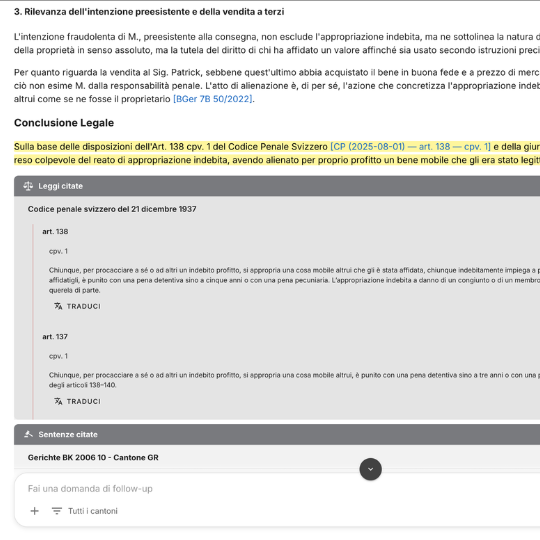
Structured responses with verifiable citations
Reduced latency through parallel architecture
Maximum security and compliance
DeepLegal demonstrates how Agentic RAG architecture can overcome the limitations of traditional RAG systems, offering a distributed intelligence that replicates the way a team of legal experts would collaborate on complex research.
You may also be interested in

AbaClik: your AI-powered voice assistant for back office operations