Preserving the Ticino Dialect with AI: A Case Study at the Intersection of Technology and Culture
In the broader conversation about artificial intelligence, language plays a central role. Yet it is often associated exclusively with well‑established applications such as machine translation or multilingual virtual assistants. What is rarely considered, however, is the potential of AI to help preserve local cultural heritage, particularly regional dialects at risk of disappearing.
It is within this context that Artificialy developed one of its most culturally meaningful projects: a language model enriched with translation capabilities to and from the dialect spoken in Canton Ticino. We recently shared the story in Corriere del Ticino and in interviews with RSI.
The idea emerged almost by chance, during a dinner among entrepreneurs. A conversation about language models became intertwined with exchanges in the Ticino dialect. The technical challenge was immediately evident: building a functional model in a very short timeframe, starting from a language that, although vibrant in oral tradition and everyday speech-lacks the structured digital datasets available for official languages.
Data Collection: A Multidimensional Challenge
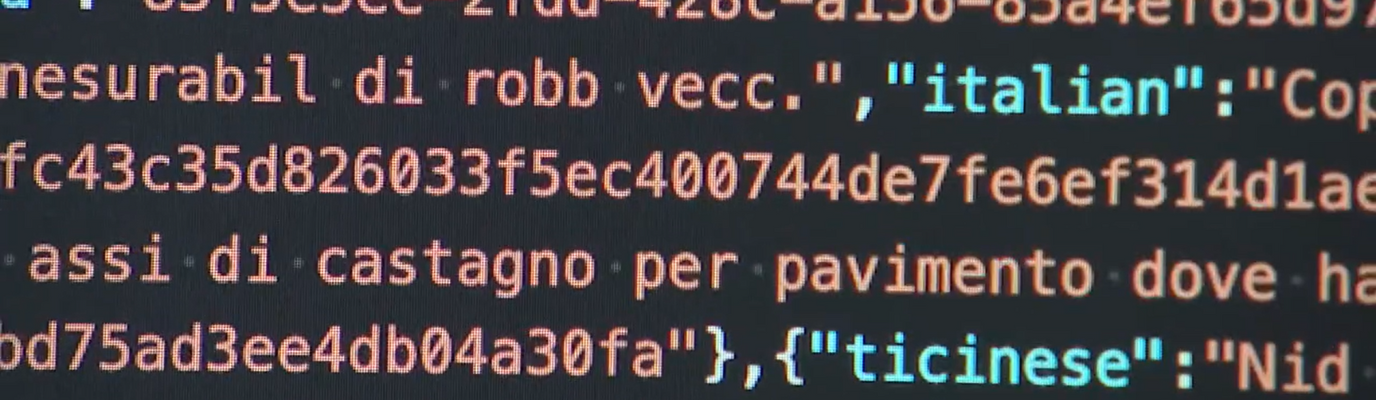
The first phase of the project required an intensive period of data collection. The initial primary source was the digitization of historical books and documents, anything but a trivial process. One of the challenges stemmed from the fact that old Ticino dialect contains characters not found in standard Italian, such as a grapheme combining both an accent and a diaeresis on the letter “i,” making it impossible to rely on standard Optical Character Recognition systems.
After testing several open‑source OCR tools, Artificialy developed an internal proprietary solution capable of handling the graphical peculiarities of the dialect. Even more unexpectedly, scan quality proved to be crucial: as an anecdote, the team discovered that dawn and dusk light provided the ideal conditions for digitizing the “ancient texts.”
Data Cleaning and Normalization
The first datasets collected were largely composed of literary texts from the 1950s and 1960s, often characterized by a rustic tone shaped by popular storytelling traditions. As a result, the vocabulary frequently included colorful expressions unsuitable for a general‑purpose translator. This made an extensive cleaning and normalization phase essential.
The Ticino dialect is marked by strong territorial fragmentation: for the same concept, four or five different lexical variants may coexist, each tied to a specific geographic area. To address this complexity, the team adopted a standardized version of the so‑called “railway Ticino dialect,” which historically spread more uniformly thanks to the development of railway lines connecting the main centers of the canton.
A key reference for terminological disambiguation was the Lessico and the Vocabolario produced by the Centro di dialettologia e di etnografia in Bellinzona, which helped establish a more consistent standard form of the dialect. This approach enabled more coherent and unambiguous translations while reducing redundancy and lexical ambiguity.
Strategic Dataset Enrichment
During the training phases, the team identified a significant gap between the literary language prevalent in the dataset and the way real users would interact with the model. To bridge this divide, literary and theatrical works, which often exist in both Ticino dialect and Italian, played a fundamental role. These sources not only expanded the corpus but also helped normalize the language and improve the model’s grasp of natural conversational and syntactic structures. The integration of poems and songs further strengthened the model’s ability to handle diverse linguistic registers and formats.
Another technical challenge concerned verb tenses. In spoken Ticino dialect, the present tense dominates, a peculiarity that, in early iterations, confused the model. The treatment of auxiliary verbs, which differ significantly from standard Italian, also required targeted interventions. In this phase, the team used data‑augmentation techniques developed in collaboration with domain experts who provided precise linguistic guidance.
Through this methodical and iterative approach, the dataset was progressively expanded to reach several tens of thousands of carefully mapped words across the reference languages and the Ticino dialect.
Model Architecture
In terms of architecture, the choice, made last year, fell on Mixtral, an open‑source model with a particular focus on European languages, including Italian. This decision proved strategic: Mixtral uses a “mixture of experts” structure, where a general model coordinates specialized verticals focused on specific domains. This structure enabled strong performance even with relatively limited datasets compared to more mainstream languages, while also offering a robust starting point in Italian, which the team then used as a bridge to teach the model the Ticino dialect.
The training process was structured in iterative cycles and progressed hand‑in‑hand with dataset refinements. The first version produced translations that were excessively colorful or overly formal, inherited from historical texts. The second and third iterations suffered from accuracy issues due to noise in the dataset. Only around the tenth version did the team begin to obtain strong results and systematically validate the output in preparation for an initial model release.
Validation required specific expertise: a project manager fluent in the dialect developed a set of test phrases unseen during training to ensure reliable quantitative metrics. The results from this evaluation led to an additional training cycle before achieving a satisfactory quality level.
Impact and Future Outlook
The model was officially introduced through a press release and presented at an event dedicated to the local scientific community. Interest quickly grew beyond the technical realm: several organizations contacted the team for similar projects involving other minority regional languages, such as Ladin. Indeed, the methodology is replicable for other “rare” languages, provided that sufficient written sources are available.
From a commercial perspective, some companies have explicitly requested Ticino dialect as a language option in their services, demonstrating how strongly the dialect remains tied to local identity.
The most inspiring potential lies in cultural preservation and dissemination: the model could be integrated into digital avatars in museums or cultural institutions, offering immersive experiences in the local language.
Technical Reflections and Replicability
This project was made possible thanks to Artificialy’s proprietary training infrastructure. For enterprises without dedicated computational resources, developing similar models would be prohibitively expensive.
A frequently underestimated technical factor concerns tokenization: language models convert text into binary code through tokens, but different languages require different tokenization strategies. Optimizing this process for minority languages is an additional challenge requiring specialized expertise.
The Ticino dialect model demonstrates how artificial intelligence can serve not only as a tool for innovation but also for preservation. At a time when many regional dialects are at risk of disappearing, technology offers unprecedented opportunities to breathe new life into valuable linguistic and cultural heritage.